Large-Scale Fertilizer Equipment Manufacturer

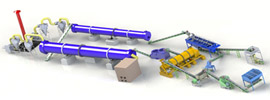
Cat litter granulation production process

Cat litter granulation production process

Broken Cat Litter (Extrusion-Crushing Method) Granulation Process

  1. Mixing and Moistening: Combine bentonite powder with an appropriate amount of water to form a material with a certain level of humidity and plasticity.
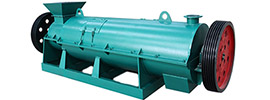
  2. Extrusion into Strips: Feed the moistened material into an extruder. Through the thrust of the screw, the material is forced out through a mold with specific pore sizes, forming dense, uniform cylindrical strips.
  3. Crushing and Cutting into Granules: Send the extruded continuous strips into a crusher. Rotating blades cut and break the strips into irregularly shaped small granules of varying sizes.
  4. Drying and Screening: Dry the crushed wet granules and then screen them to obtain finished products that meet the specifications.

Spherical Cat Litter (Pan Granulation Method) Granulation Process

  1. Pan Granulation: Feed the powder into an inclined, rotating pan granulator. Under the rotation of the pan, the powder particles roll along with it. Due to capillary and van der Waals forces, slightly moist powder particles collide, adhere, and wrap around each other, gradually spontaneously agglomerating into spherical shapes.
  2. Drying and Screening: Dry the granulated spherical particles and then screen them to obtain finished products that meet the specifications.

Cassava Cat Litter Granule Granulation Process

  1. Raw Material Preprocessing and Mixing:

    • The main materials are cassava starch or dehydrated cassava residue (with a moisture content of ≤12%). First, they need to be crushed to 80-100 mesh using a pulverizer to ensure uniform particle size.
    • Auxiliary materials include natural binders (such as guar gum and xanthan gum), plant fibers (bamboo powder and sugarcane bagasse), deodorants (activated carbon and zeolite powder), pigments (optional), etc.
    • All raw materials are automatically metered according to the formula ratio using loss-in-weight feeders or volumetric feeders and then pre-mixed in a twin-shaft paddle mixer as dry powders to ensure uniform composition. The mixing time is about 5-10 minutes, and the coefficient of variation (CV) of the mixing uniformity is ≤5%.
  2. Conditioning and Maturing (Optional):

    • To enhance the plasticity and adhesion of cassava starch, some processes include a conditioning and maturing unit. Hot water or steam is sprayed into the mixed powder to increase the moisture content to 20%-25%.
    • The material is then kept warm and matured in a closed mixer for 5-15 minutes to fully gelatinize the starch and enhance its adhesion. The matured material appears as a wet, soft mass, which is conducive to subsequent extrusion molding.
  3. Extrusion Granulation:

    • The matured material enters a twin-screw extruder or a flat-die/ring-die pellet mill for molding. The twin-screw extruder extrudes the material into strip or columnar granules through molds with specific diameters (3-6 mm). The length of the extruded granules is controllable, and they have a smooth surface and dense structure.
    • The flat-die/ring-die pellet mill presses the material into the mold holes using pressure rollers for molding. The molds need to be cleaned regularly to prevent clogging. The wet granules extruded from the machine have a moisture content of about 20%-28% and need to immediately enter the polishing process to prevent deformation or adhesion.
  4. Polishing into Spheres:

    • To improve the sphericity, surface smoothness, and appearance quality of the granules, the wet granules enter a polishing machine for shaping.
  5. Drying and Screening:

    • Dry the shaped granules and then screen them to obtain finished products that meet the specifications.

Quick Contact

Wulong Industrial Cluster, Zhengzhou, China
+8615303836406
+86-15303836406