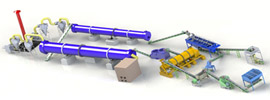
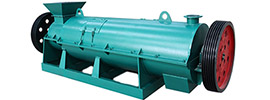
The growing preference among organic fertilizer manufacturers for extrusion granulation technology stems from its process adaptability, cost-effectiveness, product performance, production flexibility, and environmental sustainability, as detailed below:
1. Process Adaptability: Overcoming Raw Material Limitations for Efficient Conversion
Organic fertilizer raw materials—such as livestock manure, straw, sludge, and other high-fiber or heat-sensitive materials—pose challenges for traditional granulation methods (e.g., disc or drum granulation). These methods require fine particle size reduction and high moisture content during granulation, leading to heavy drying loads and significant loss of bacterial activity. In contrast, extrusion granulation forms particles through high-pressure physical aggregation, eliminating the need for chemical binders. It achieves a shaping rate exceeding 95% with low moisture content (typically below 15%) in the final particles, reducing drying loads, minimizing bacterial loss, lowering dust emissions, and creating a more operator-friendly environment. For example, flat-die extrusion granulators can directly process fermented organic materials without prior drying or crushing, producing cylindrical granules while saving substantial energy.
2. Cost-Effectiveness: Reducing Investment and Operational Expenses
- Lower Equipment Investment: Extrusion granulators feature simple structures, compact footprints, and affordable installation costs, making them ideal for small-scale producers. For instance, small extrusion granulators cost 1/3 to 1/2 the price of drum granulators and eliminate the need for auxiliary drying and cooling equipment, further cutting costs.
- Reduced Operational Costs: Extrusion granulation requires no heating or drying, consuming 50–70% less energy than traditional methods. For a 10,000-ton/year organic fertilizer plant, this translates to annual electricity savings of approximately $28,000 (USD). Additionally, maintenance is straightforward, with low replacement costs for wear parts (e.g., sieve molds and cutting knives), ensuring long-term cost advantages.
- Higher Raw Material Utilization: Extrusion granulation minimizes dust generation, with material loss rates below 5%, compared to 15–20% in traditional processes, significantly improving raw material efficiency and reducing costs.
3. Product Performance: Enhanced Particle Strength and Stable Nutrient Release
- Superior Particle Strength: High-pressure extrusion increases molecular interactions, yielding granules with higher density and compressive strength (e.g., >8 Newtons for flat-die extrusion granules). This reduces breakage during transportation and storage, minimizing nutrient loss.
- Stable Nutrient Release: Cylindrical granules maintain consistent specific surface areas, enabling balanced interaction with soil moisture and microbes. This results in slow, sustained nutrient release (60–90 days) aligned with crop growth cycles, compared to 30–60 days for traditional methods.
- Preserved Microbial Activity: The low-temperature process (typically <50°C) better retains nutrients and microbial viability. Studies show >90% microbial survival in extrusion-granulated fertilizers versus 70–80% in traditional products.
4. Production Flexibility: Adapting to Diverse Needs
- Broad Raw Material Compatibility: Extrusion granulation handles high-fiber (e.g., straw), heat-sensitive (e.g., manure), and moisture-variable materials (e.g., sludge), catering to varied manufacturer requirements.
- Scalable Capacity: Equipment ranges from small-scale (1 ton/hour) to large-scale (5 tons/hour) models, supporting both family farms and industrial-scale production.
- Versatile Product Shapes: Extrusion produces cylindrical or flake-shaped granules, which can be polished into spheres for improved flowability (e.g., for mechanical sowing) or retained as cylinders for stable basal application.
5. Environmental Sustainability: Aligning with Green Development
- Zero Waste Discharge: The process avoids chemical binders and generates no wastewater or exhaust emissions. For example, flat-die granulators operate in closed systems with dust emissions <10 mg/m³ (well below the national standard of 30 mg/m³).
- Energy and Emission Reductions: By skipping drying/cooling steps, extrusion granulation cuts energy use and CO₂ emissions. A 10,000-ton/year plant can reduce emissions by ~100 tons annually, aiding carbon neutrality goals.
- Resource Circularity: The technology converts agricultural waste (e.g., manure, straw) into high-value fertilizers, closing nutrient loops. For instance, 1 ton of manure yields 0.6 tons of organic fertilizer while reducing odors and pathogen risks.





 Send us a Email
 Wulong Industrial Cluster
 Have any question?